
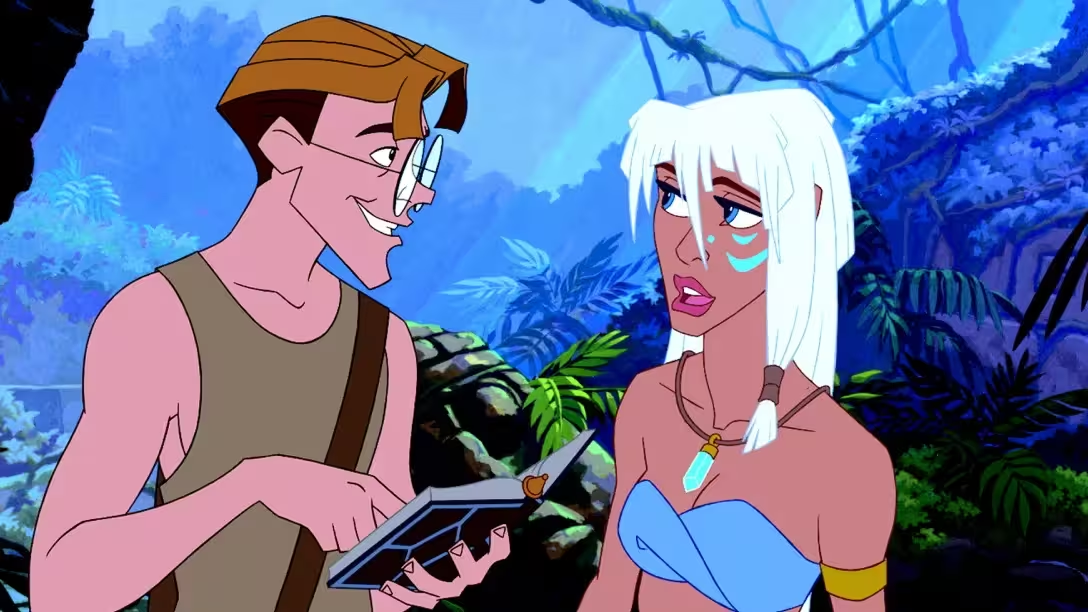
Atlantis: The Lost Empire shares a sad distinction with Treasure Planet: they were a double flop that would ultimately mark the end of an era at Disney. To this day, 25 years later, Milo’s adventures in particular are still a subject of debate, with some seeing them as a bold experiment and others as a clumsily conceived work. Where does the truth lie?
A Disney film unlike any other
Looking back at Atlantis: The Lost Empire means confronting a time when everything at Disney seemed destined for immediate and unqualified success. At least that’s what Don Hahn, Gary Trousdale, Kirk Wise, and Tab Murphy thought. They were the ones who had created The Hunchback of Notre Dame, hailed by audiences and critics alike as yet another masterpiece of that Disney Renaissance that, since The Little Mermaid, had propelled Disney back into the limelight. They met at a Mexican restaurant, and amid chili, tacos, and tequila, they decided it was time to put adventure back at the center of everything in a new project. Atlantis seemed like the perfect inspiration. Ever since Plato’s Dialogues in “Timaeus and Critias,” the myth of that lost continent had fueled theories, legends, and curiosity for centuries; it had been the source of countless stories and narratives for ages. So why not capitalize on it? No sooner said than done, a $90 million budget was secured, which then ballooned (and here we can already sense the excitement that reigned at Disney at the time) to $120 million as if it were nothing.
Trousdale and Wise finally had a script that Tab Murphy inherited from Joss Whedon, which he heavily reworked. Atlantis: The Lost Empire was originally supposed to begin with a Viking-inspired sequence, but it was ultimately decided to simply depict the disappearance of the mythical island, with an apocalyptic scene that alone suffices to show how the film broke completely away—in terms of pacing, atmosphere, and composition—from everything the Disney Renaissance had been up to that point. This was further underscored by the total absence of musical scores, since the film was conceived from the outset as a pure and simple adventure, drawing on the diverse spirits of the entire fantasy genre—whose great founding fathers included Jules Verne, Arthur Conan Doyle, H. Rider Haggard, and Edgar Rice Burroughs. It did not escape many people’s notice, then, that there was a whole series of similarities with the typical atmosphere of the Indiana Jones films, despite the fact that the protagonist, Milo Thatch, was a far cry from the heroic adventurer played by Harrison Ford.
Some have rightly pointed out the connection to Roland Emmerich’s Stargate. In fact, like Daniel Jackson, Milo is a young scholar convinced of Atlantis’s existence, but every one of his hypotheses and ideas is stifled and mocked by the scientific community. There is that “Diary of the Old Shepherd” he has been hunting for a very long time, which he is certain could lead him to Atlantis. The wealthy Preston B. Whitmore, a friend of Milo’s grandfather and an explorer himself, will provide him with the right opportunity. Before long, we find ourselves inside a futuristic submarine. The large crew includes, among others, Commander Lyle Rourke, the dangerous Helga Sinclair, Vinny Santorini, Dr. Dolce, Gaetan Moliere, Audrey Ramirez, Mrs. Packard, and the cook Farnsworth. They will discover that Atlantis is still alive—a submerged civilization as ancient as it is futuristic, equipped with an energy source, vehicles, and a culture that is both parallel to and completely different from what Milo and the others know in 1914.
Too bad that before they get there, they have to face a Leviathan, a mechanical monster that destroys the submarine and nearly all its occupants. Two massacres already before the halfway point of the film—not bad for a Disney Classic. Atlantis: The Lost Empire also visually breaks completely from the Disney Renaissance; the style of Mike Mignola, one of the most important comic book artists of his generation, is the main source of inspiration, so much so that he was even enlisted as a graphic consultant and chief production designer. The film gives a big nod to the Adventure serials of the 1930s and 1940s, to the pseudoscience and alternate history that had dominated modern science fiction. However, there are also very strong connections to Japanese anime, the films of Hayao Miyazaki, Art Deco, and the cinema of Méliès; in short, Atlantis: The Lost Empire is a massive creative melting pot, designed for an audience under 25, but not for children. In hindsight, this will be one of the clearest explanations for its commercial failure, combined with the fact that it is, in every respect, a film that has little in common with Disney.
A film too different from what audiences were looking for
Watching it today, a quarter of a century later, it seems to borrow heavily from the films of Don Bluth, who was known for treating younger audiences with maturity. Similarly, this film is no shortage of destruction, fear, and even a few horror elements. Rourke turns out to be the villain alongside Helga, driven by greed, and a certain colonialist spirit lives on in him. It is no coincidence, in fact, that Atlantis: The Lost Empire, in addition to being a massive adventure, is also connected to New Age philosophy, and some will even point out the link to Dances with Wolves and the cinematic style of that era, which completely overturned the vision of the discovery of new worlds and the relationship between civilizations throughout history. The visual style is fascinating, as Atlantis is not a copy of ancient Greece but a blend of various Central and South American cultures, as well as those of the Pacific and Asia. It took a team of 350 animators to bring it all to life; anamorphic 35mm film was chosen, a nod to the old CinemaScope format—in short, it was the most technically complex production Disney had ever attempted up to that point.
CGI was used extensively, but still in the service of classic 2D animation—a choice that was perhaps not very wise. It’s often said that action defines characters; here, however, a great deal of screen time was devoted to dialogue and interactions within this ragtag band of utterly charming troublemakers. In hindsight, however, it must be said that Rourke as the villain comes across as far too generic, much like he did in the otherwise beautiful Tarzan two years earlier, and as he would again in Treasure Planet the following year. Atlantis: The Lost Empire had in Milo a likable, very human protagonist, who, however, lacked charisma and perhaps also a certain ability to express a talent that would redeem him from being a leaf at the mercy of events. Even Princess Kira, however charming and visually intriguing she may be, with her blending of East and West, is not a particularly complex character. Perhaps the whole thing seemed like a series of lush landscapes, costumes, and vehicles of a civilization that was even given a language invented for the occasion.
“Atlantis: The Lost Empire” may have aimed too high for adult audiences; the action didn’t really pick up until the end and didn’t offer anything new, and it certainly seemed a bit boring to younger viewers. However, the film’s overall reception to date can only be largely positive, thanks to the boldness of the project itself and its determination to break away from the stale, familiar tropes of Disney. Just a few weeks earlier, in fact, Shrek had demolished that old, stale world across the globe. Perhaps Atlantis: The Lost Empire, like Treasure Planet, was an undeserved box office flop because it was overtaken by events—by an animation trend that, with the Toy Story saga, Antz, and A Bug’s Life, had rejected traditional animation in favor of computer graphics. It was as if the Millennial generation was demanding something different, something of their own, far removed from what previous generations had seen in theaters. They wanted more complex characters and fresh stories; simply drawing inspiration from literature, myths, or legends of the past was no longer enough.
Atlantis: The Lost Empire was a terrible box office flop, and the theme parks and merchandise never even got off the ground. The same fate befell another Disney gem, The Emperor’s New Groove, another attempt to move beyond Disney’s classic style. But 25 years later, looking at how James Cameron later reused many of the ideas found here—linking them to the aforementioned Dances with Wolves, Aida of the Trees, FernGully: The Adventures of Zak and Crysta, and the famous story of Pocahontas—it must be said that perhaps it was simply unlucky to be released at the wrong time and failed to find its niche. The story was solid, as was the decision to move away from catchy little songs. Atlantis: The Lost Empire remains a compelling, creative Disney Classic with an interesting environmental and humanitarian message, simply lacking the ability to connect with a market that had shifted profoundly. It possessed a creative boldness that should be revived today, in the face of animation that has become increasingly didactic and less and less thrilling.
