

“Disclosure Day” could be described as a distillation of Spielberg’s philosophy, of his vision of the unknown, of science fiction as a representation of a dream, a chimera, but above all a metaphor for who we are, who we could be, and who we should be. Twenty years after terrifying us, Steven Spielberg delivers a film filled with self-references and homages, but above all a heartfelt appeal to our humanity. In theaters tomorrow.
“Disclosure Day” – The Plot
For Daniel Kellner (Josh O’Connor), the situation is desperate. A cybersecurity officer at the powerful multinational Wardex, he has stolen classified information and is trying to make it public. At least, that is the plan of Hugo (Colman Domingo), a former Wardex employee and now the leader of a group of activists who believe that the power held by Noah Scanlon (Colin Firth), Wardex’s CEO, is a danger to humanity. Unfortunately, Daniel is discovered and forced to flee with his girlfriend Jane (Eve Hewson), hunted across the country by Wardex’s henchmen.
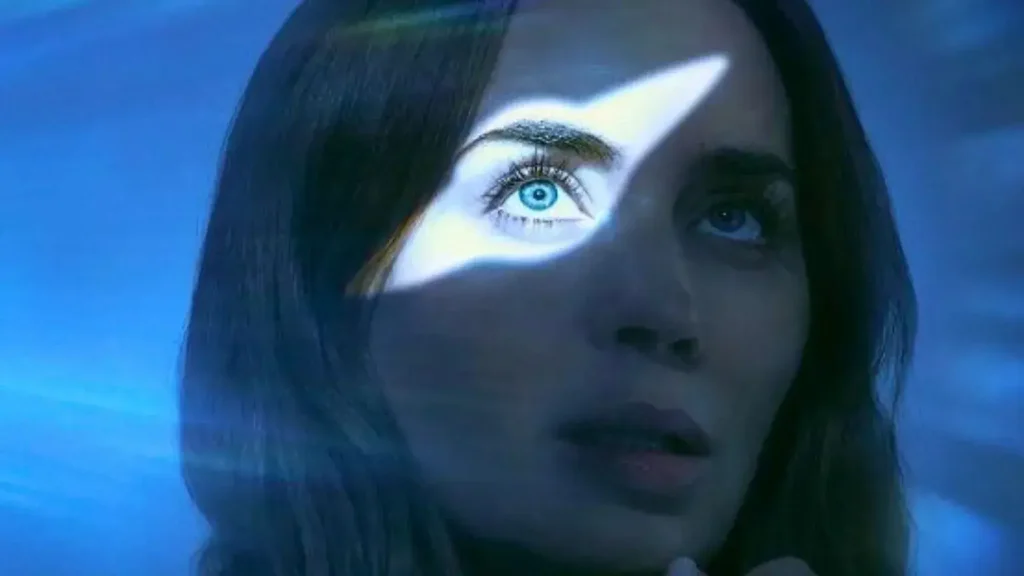
Meanwhile, meteorologist and journalist Margaret Fairchild (Emily Blunt) is trying to turn her career around; she doesn’t know whether to stay in Kansas City with her boyfriend Jackson (Wyatt Russell) or try her luck elsewhere. Within a few hours, Margaret begins to act strangely, showing signs of instability that no one—not even she—can logically explain. Meanwhile, Daniel continues his escape, hot on his heels is Scanlon, determined to prevent the stolen information from forever changing the course of human history and confronting us with a shocking truth.
Democracy under attack. Between super-billionaires and manipulation
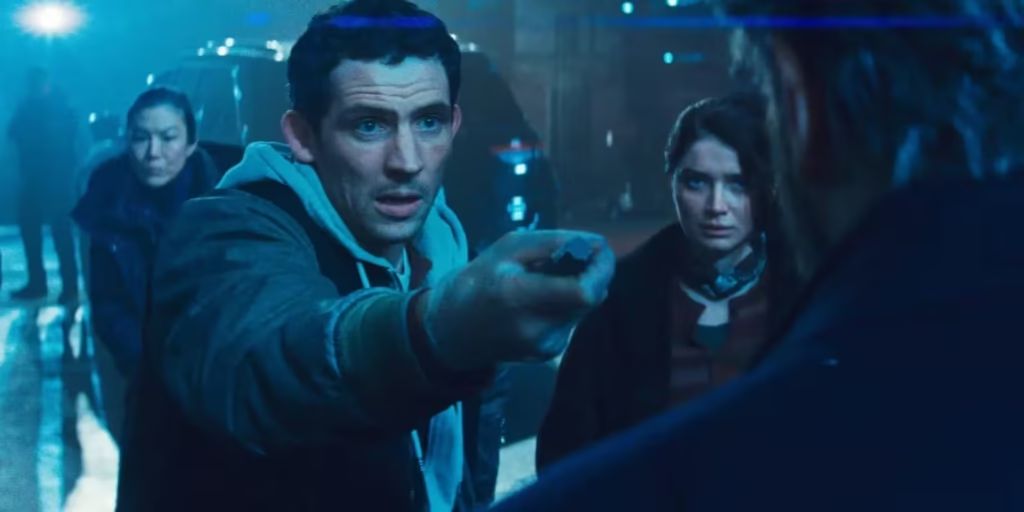
Last time, Steven Spielberg told us about alien invasions, about the War of the Worlds imagined by Wells. That was in post-9/11 America, engaged in the Middle East; this America of 2026, however, is under the thumb of Trump, but above all of a small group of CEOs and super-billionaires who influence democracy and freedom of expression, using fear and manipulation. It doesn’t take a genius to see that the character of Noah Scanlon is a sort of blend of the many tech gurus of our time, just as it’s easy to hear the warning cry Spielberg issues against the passivity of the masses.
“Disclosure Day” is much more than just a movie about aliens; it’s a blend of conspiracy theories, alternate history, science fiction, and mystery, all wrapped up in a thriller that never feels overly intense. Spielberg also incorporates a religious element, addressing free will and the deep-seated conflict (at least in America) between science and religion, while presenting an objectively acceptable middle ground and positioning himself as a narrator capable of reminding us what matters and what doesn’t. All of this unfolds within a narrative that tugs at the strings of uncertainty, and at times the paranormal, revisiting the genre’s tropes from the era when the Cold War reigned supreme over everything and everyone.
Perhaps, in the end, we are the real aliens
“Disclosure Day” benefits from a screenplay by David Koepp (no slouch himself), which draws heavily—very heavily—from authors like Jack Finney, Harry Bates, and the aforementioned Wells, but then winks at Steven Spielberg himself and his signature works. There are numerous references to “Close Encounters of the Third Kind,” “E.T. the Extra-Terrestrial,” “Minority Report,” and even “A.I. Artificial Intelligence.” “Disclosure Day” connects to conspiracy theories and ufology, from crop circles to Area 51, the Roswell incident, and the legacy of what shaped our imagination in the 20th century, when space became the new frontier of the unknown.
Dominating everything and everyone is a brilliant Emily Blunt. Her Margaret is a peculiar character, a mix of slapstick-style clumsiness reminiscent of silent-film comedy and the kind of unintentional heroism typical of Spielberg. Through her and O’Connor’s Daniel, we return to the theme of the loneliness of those who are different from the norm, with children serving as a symbol of a curious, empathetic, and unbiased perspective. The ultimate goal? To remind us that every alien we have imagined or created was nothing more than a representation of our own unspoken fears.
Colin Firth is the perfect vehicle through which Spielberg turns this carousel of mysteries, inner monologues, and deliberations on what the masses should and shouldn’t know into a portrayal of the evil of our time—one built on media control and a narrative distorted by “Fascism 2.0.” “Disclosure Day” may have a somewhat sluggish central section and is a bit too saccharine (a minor flaw we’ve always forgiven Spielberg for), but it has an incredibly powerful ending, in which the director returns to playing with our collective emotions with a skill he hadn’t displayed in years. Are we alone in the universe? Wrong question—perhaps we are alone in this universe, on this Earth; we have become consumers, a herd, instead of pursuing independent thought and collective hope.
It’s hard to predict whether—or how much—the film will gross, as younger generations haven’t shown much enthusiasm for Steven Spielberg’s films. But it is and remains one of his best films of this century—a great science fiction film where ideas, emotions, and his desire to make us understand that, in the end, the evil we create is part of that fear of the unknown that we should fight, not embrace, matter more than the visual spectacle.
