
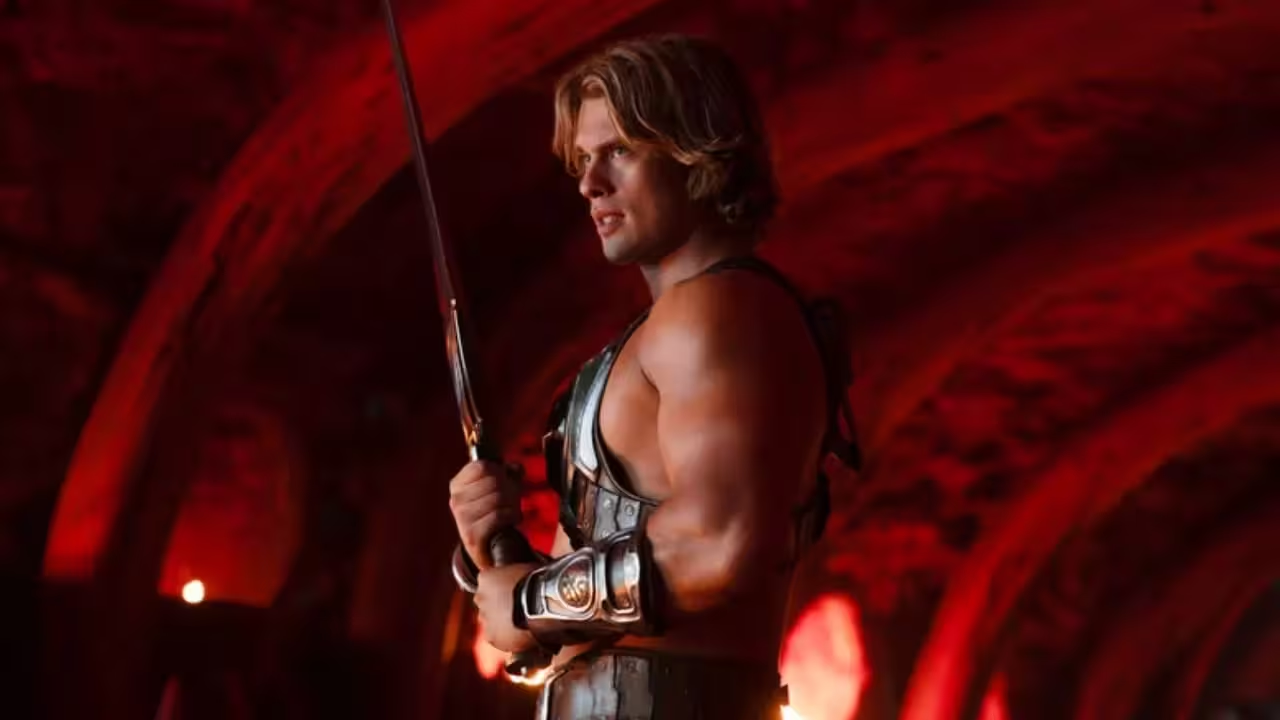
The term “He-Man” has existed in American slang long before Mattel conceived a character with that name for a toy line. It identifies a person who uses strength and wants to show off their muscles. Perfect for describing that character, who was characterized precisely by the pronounced musculature he displayed when he transformed from a shy prince into the defender of Eternia. During the years of Reagan-era hedonism and Schwarzenegger, all of this was viewed favorably (the toy line was originally intended to be merchandise for Conan the Barbarian, but Mattel wanted to create something of its own, without straying too far from the source). Today, that model of masculinity is viewed with far less favor in any film not starring Jason Statham. Inevitably, then, the new Masters of the Universe film can’t help but revolve around this theme.
Even the last people in line get it when the camera cuts to Adam at his desk in his office job on Earth, and we see his name tag with the pronouns “he/him” written below. It’s one of the many clever ways director Travis Knight sets the stage for the entire opening. After we see 10-year-old Adam fleeing Eternia following the arrival of the evil demon Skeletor, who has taken his parents hostage, his life becomes a constant struggle to return. Earth is, in fact, where Adam is hidden along with the sword that will allow him to return—a sword that is, however, lost immediately. He has only his memories of that time and those people, which no one believes, and his personal quest for the sword.
At the beginning of this film, which evokes a strong sense of nostalgia for the 1990s (at one point, Queen’s “Princes of the Universe” is even featured in the soundtrack), the protagonist almost seems to be in a film, precisely, from the late 1990s, when in American cinema it was very common for protagonists to have office jobs, regular, middle-class, problem-free lives, yet feel the need for something else, to sense the existence of something more. Neo from The Matrix had it, the narrator of Fight Club had it, and the protagonist of Being John Malkovich had it. And Adam has it—when he finds the sword, he drops everything to go retrieve it, setting the real plot in motion. That’s the moment when the film begins to slowly go downhill.
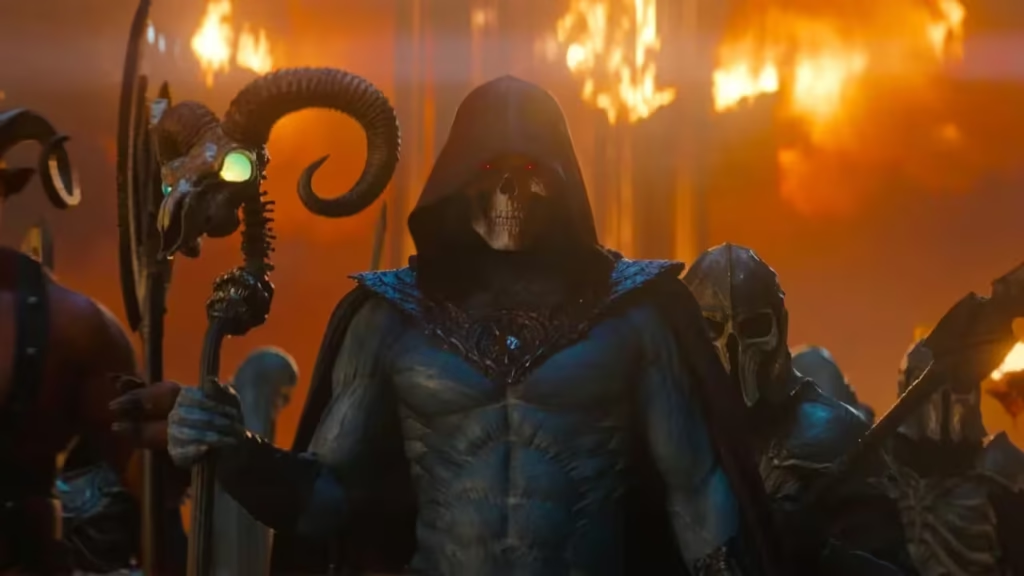
While it starts out dynamic and full of creative twists in the style of Edgar Wright (what a great transition from the slowed-down version of “Boys Don’t Cry” to the original!), Master of the Universe eventually has to become an adventure film—without quite knowing how to stay original. All in all, it becomes the story of a nerd who meets his heroes—the warriors he knew as a child and has drawn his whole life, waiting to return to Eternia. To him, they’re like superheroes, and besides, with the sword, he himself will gain powers that will make him (practically) a superhero. That’s the narrative structure. The most interesting part, then, should be the fact that while as a child he didn’t seem cut out for combat and elicited only contempt from his father and pity from others, and as an adult he is a somewhat cowardly man unsuited to combat and violence—which disappoints everyone because they expected a savior—when he becomes He-Man and starts throwing punches, he is finally viewed with esteem, respect, and enthusiasm. Now he is what society expects him to be. It should be a triumph, but it feels like a defeat.
Essentially, the world around Adam demands that he conform and act macho, that he settle everything with his fists and “be a man,” but on Earth he has learned to communicate; he’s a good human resources employee. This is the film’s central conflict and what it sets out (on a higher level) to resolve. Spoiler: he doesn’t succeed. Masters of the Universe aims to hold these two dimensions together and assert that a man can be everything: he can listen and resolve issues by avoiding conflict, but he can also beat demons to a pulp with his bare hands. However, it would take writing of a decidedly higher caliber to pull off this argument. Instead, in one scene, He-Man, before starting to fight, half-heartedly tries to negotiate and approach it dialectically, but at the first sign of failure, he gets fed up and seems to think, “Well, when you gotta do what you gotta do.” And so the beating begins. And so every time the film tries to be epic and adventurous in the classic sense, it does something to undermine it, without coming across as truly self-deprecating but merely indecisive. For a long time.
It’s a two-hour-and-twenty-minute adventure, action, and epic film set in a world that seems to be imagined like the Asgard of Thor: Ragnarok (full of color) and filmed like Middle-earth from The Lord of the Rings. Two hours and twenty minutes in which not that much actually happens, but every single scene is unnecessarily drawn out. It’s clearly a movie aimed at kids between the ages of 7 and 15, and that’s perfectly fine—except that this target audience might not even know who these characters are (there are cartoons made today, but they aren’t all that popular).
In short, one might have expected a bit more boldness in tackling a character who is certainly not easy to modernize. Obviously, the fact that the aesthetic of the action figures and the original cartoon was (by today’s standards) incredibly queer isn’t even considered, just as no one seems to care about the absurdity that Adam, in his weak and defenseless version, is clearly big and muscular, merely covered by clothes meant to hide it. It doesn’t seem to be a problem for the film that the main villain is interested in the sword; then it becomes clear that the sword isn’t really important because the power lies within Adam, and so the villain is left with no goal other than being a villain. The only thing that is crystal clear, well-framed, and perceived by everyone in this Amazon/MGM-produced film is that when a monster invades our cities, terrorizes everyone on the streets, and is about to kill the protagonists, what saves them is the arrival out of nowhere of an Amazon Prime delivery truck that runs it over: “Always on time and ready to save subscribers.”
